Who Was Wittgenstein?
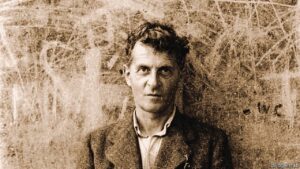
My next (and final:O) book, “Understanding Wittgenstein’s Authorship,” is now available, and I assume you have a copy. Since not all Youse folks are familiar with him and his work, I thought I’d provide a brief introduction.
Ludwig Wittgenstein (1889–1951) was born and raised in Vienna in an aristocratic family. Part of his early education was spent in nearby Linz, where he was briefly a classmate of Adolf Hitler. He then studied at an engineering school for several years before transferring to the University of Cambridge in England. He had read Bertrand Russell and Alfred North Whitehead’s “Principia Mathematica” and went there to study with Russell (Whitehead had already shifted to the University of London). Impressed by Russell’s work, Wittgenstein aimed to write his own shorter version of its principles in his handwritten “Tractatus Logico-Philosophicus” (written partly during his service in the Austrian Army, including a period as a prisoner).
He sent a copy to Russell, who was then overwhelmed with praise for the manuscript. After the war, Wittgenstein visited and studied with Russell at Cambridge. Russell even wrote a preface for the publication of Wittgenstein’s Tractatus, filled with extraordinary praise. In short, this book propelled Wittgenstein to the forefront of philosophy at the time. He had not yet taken any philosophy classes. During World War II, Wittgenstein worked as a hospital aide near Cambridge.
After the war in 1947, he enrolled at Cambridge as a doctoral student. In a couple of years, he received a Ph.D., with Russell and G.E. Moore serving as his examiners. The Tractatus was his thesis, which, thanks to Russell’s support, was soon published widely and even became a sort of “bible” for the “Vienna Circle” thinkers like Rudolph Carnap and Hans Reichenbach, who were leading logical empiricists. It is said to contain the ideas of the “Early Wittgenstein.”
By 1929, Wittgenstein had “retired” from philosophy and moved back to Vienna, where he spent about 15 years working as a gardener, a junior high school teacher, and an architect for one of his sisters’ new houses. Suddenly, he returned to Cambridge to teach as a professor, drawing on his fame from the Tractatus.
The problem was that during his years living and working in and around Vienna, Wittgenstein almost completely changed his views. During his years as a professor at Cambridge, he aimed to present his new ideas about the relationship between language and thought. He sought to express these ideas in his Philosophical Investigations, which has become known as the key text containing the thoughts of the “later Wittgenstein” and perhaps his most influential philosophical work.
Today, we have two Wittgensteins: the “Early” Wittgenstein, whose main work and Tractatus remain a classic for the “Logical Empiricist” school—still somewhat active but waning—and the “Later” Wittgenstein, whose Investigations continue to be the focus of ongoing Wittgensteinian studies and inspire many other fields.
My own book aims to offer another perspective on the later Wittgenstein, emphasizing his dissatisfaction with the lack of clarity in his Investigations. In my view, Wittgenstein’s final efforts to clarify the relationship among language, thought, and reality arise from his attempt to find a new way to connect these three essential aspects of human experience. I suggest viewing Wittgenstein’s later work as an effort to harness the “creative” power of speech to engage and communicate the dynamic connection between reality and thought. I propose that, in his Investigations, he functions almost as a “poet,” crafting numerous metaphorical images to illustrate his insights. His writing in the Investigations is rich with “earthy” and bodily metaphors.