WHY DID JESUS DIE?
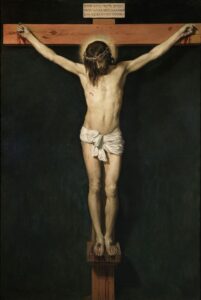
(Diego Velázquez – “Christ Crucified” – 1632)
This is a theological question, not a historical one. Early Christian theologians debated it seriously, but modern thinkers and believers no longer do. Historically, we know that Jesus died when the Jews and Romans in Jerusalem hanged him on a cross, branding him a heretic or an enemy of the state. Yet Christian theologians have long debated the theological and cosmic meaning of Jesus’ death. Meanwhile, most Christians today give little thought to the real meaning of Jesus’ death on the cross.
At my fundamentalist college and my conservative seminary, we students were taught to think through its implications to a satisfactory conclusion. In college, I was taught to believe the “Substitutionary Satisfaction” view of the death of Jesus, namely that he died as our human substitute to satisfy God’s demand for justice. In that view, the “wages of sin” were said to be eternal death, and Jesus’ death paid the debt for all humankind. Unfortunately, it never explained why this “penal satisfaction” controlled even God, the creator and ruler of the universe. Surely a better explanation must exist.
Alternative theories held that God owed a debt to the Devil, which was paid by Jesus’ death. Again, these theories never explained why or how God would “owe” the Devil anything at all, or why Jesus’ death would “satisfy” either God or the Devil. Most critics of such theories quickly point out that they reflect a limited view of God’s nature, power, and love. It was not until I went to theological seminary and studied under Robert Traina that I obtained a more satisfactory understanding of the New Testament view of the “atonement.” That understanding was focused on the insights of the Swedish theologian Gustaf Aulén in his book “Christus Victor.”
Aulén’s view focused on the New Testament theme that in Jesus Christ God had conquered evil, not by sacrificing his Son on the cross, but by overcoming all forms of evil and death and by demonstrating his eternal love for humanity, not by demanding a “cosmic Sacrifice” but by intervening in human history with a dramatic demonstration of Divine Love in the person and teachings of Jesus. According to Aulén, the point is not to “pay off” any debts but to embody God’s love in the historical person of Jesus so as to teach and exemplify the meaning and reality of God’s love for humanity. The way Jesus died, allowing himself to be crucified by the Roman Government without any sort of struggle, exemplifies his commitment to his own teachings.
By receiving God’s accepting love as embodied in Christ’s life and death, humans can choose to participate in the life God gives through that love. In my view, this new way of life is found in Jesus’ “Sermon on the Mount.” As Paul says, “In Christ God reconciled the world unto himself” (2 Corinthians 5:19). No one “pays” anyone anything. Reconciliation is the key.
So, that’s the easy part. The harder part is connecting the Jesus of the Gospels with this cosmic redeemer Christ. I must admit that this is no easy task if one is committed to making some sense of the whole Incarnation issue. Clearly, Jesus lived an ordinary human life in Palestine in the early years of what we call the “Christian era.” He taught, fed, and healed many people for a few short years and then was crucified by the Roman government. So, where lies the Divinity of the Heavenly Christ? Traditionally, Christians, theologians, and everyday believers alike have rather superimposed the Divinity of Christ on the human Jesus without seeking to disentangle them.
The central difficulty is that, even though Jesus is clearly a major anomaly within his own culture and time, he was also clearly not above being abused and killed by the Roman authorities. So where does his Divinity lie? Clearly, he was not some sort of Divine “Superman” in his own time and culture. Like the many traditional theologians before us, we still face difficulty, if not physical impossibility, when it comes to connecting these two aspects of the person of Jesus/Christ. Specifically, the uncontested fact that he actually died seems to be the key problem. Are we simply stuck with this puzzle of how to combine divinity and humanity?
My own resolution is that somehow we are supposed to discern the Divine Logos “within” the human Jesus. Trying to combine or separate them, after all, Jesus clearly died, and this is not normal Divine behavior. For me, the only way to reconcile this seemingly self-contradictory puzzle is to conclude that when we have tried to separate the Divine from the human in the person of Jesus, we have failed to appreciate the radical, ingenious truth of the Incarnation: that true spirituality exists only within embodied reality. That is to say, the reality of Jesus’ incarnation of God’s spirit is in fact “within” his embodiment and can only exist in this way. We cannot “take apart” the Incarnation, as previous theologians have sought to do.
In short, there is no “heavenly glow” surrounding the man Jesus. He came into the world of flesh and brought spirituality with him. This, to be sure, is a paradox that admits no resolution. I am not urging some sort of “mysticism” here. For myself, I no longer need to resolve this puzzle. I am prepared, and have been for some 80 years, to simply accept and try to live by the teachings and example of Jesus as found in the Gospels. If that is all there is, I must say that is fine with me. If somehow the puzzle of the Incarnation has led me, along with millions of others, down some “primrose path,” so be it. It is difficult to conclude that trying to follow the example and teachings of Jesus is delusional. Their value speaks for itself. As Luther said, “I can do no other. Here I stand.”
By way of a more complete answer, I would fall back on my old standby, “mediated reality.” So many of the dimensions of reality come to us through others, just as the meaning of this paragraph and these very words is “mediated” to us through our common understanding of them in the English language. It seems magical because of our long experience with these factors, but if we recall what it was like to be a child or a foreigner, things become much clearer. In the same way, perhaps, we can understand how Jesus’ behavior and teachings can be said to “mediate” divinity and spiritual reality to us – in and through the particulars, we can grasp the whole. That is the meaning of the notion of “Incarnation”; the richer dimension of reality is mediated in and through the more familiar patterns of everyday life and thought. The former cannot be reduced to the latter, but at the same time, in and through our involvement with the latter, we can come to an understanding of the former as it is mediated to us in and through the latter. The one is “incarnated” in the other.
2 responses to “”
There is a lot to consider here, but I will be brief. God makes man “in His image”, so the great “Kenosis” of the Son of God, his emptying himself of all divinity, still does not eliminate in him what is of God in all mankind. Only the Son of God could have done this (his divine status) and only man remains after the kenosis. He then acts according to the leading and empowerment of the Holy Spirit, as all Christians today are supposed to be able to act. One cannot easily see who Jesus really is without God Himself revealing it (Mt. 16:18). The disciples were barely able to believe that Jesus was the Messiah until they saw the miracles. Seeing him as the Son of God comes a little later and mostly not for the disciples.
So I think you are right: no heavenly glow around Jesus, but what he does shocks, encourages, and dismays the world around him. His actions seem undeniably to stem from God, and “Messiah” is the buzz word people are using when they try to understand whom they are dealing with. But, as Peter and Paul affirm, he is declared the Son of God, the Lord, the Messiah, by the resurrection. Now we have a cosmic impact of the man Jesus entering the picture.
When we consider his cosmic impact, we must switch from listening to what he says to seeing who he is. While I hear a lot of people talking about the “Rabbi” Jesus, the teacher of a new way, the example of who we should be, I think we are looking the wrong way if we want to grasp his real meaning. His teachings are about the following things: the nature of the coming of the kingdom of God, what faith in the kingdom and then later in him is like, what the eschatological benefits of the kingdom are (e.g., the beatitudes), and how practicing the law from the heart and in humility is what God wants rather than a legalistic approach. There is really not much about how human beings as such, not just the Jews, should live except his doctrine that we cannot be forgiven for sin unless we forgive those who sin against us. He is also against performing sacrifices, preferring to dwell in the house of prayer and to demand a contrite heart of those would seek atonement by sacrifice. Indeed, there is a Judaistic movement among Christians today, who feel that the actual ethic of Jesus is Judaism and the Torah, while they want to accept the messiahship of Jesus and be something like Christian Jews or Jewish Christians. They see Jesus as teaching how to properly practice the law, a lesson most Jewish rabbis would insist has been heard and noted by Jews.
But what about who Jesus is? He is the second person of the Trinity (as later understood) who emptied himself of all that was divine in himself except what God has given all persons. Empowered by the Spirit, he shows what the power of God and what life will be like in the coming kingdom. He endures the natural conclusion of his actions in the violent political circumstances in which he finds himself, becoming aware in time that he will not simply be crowned king in Jerusalem and lead the nation back to holy living but will die at the hands of those who will protect their power. He submits to this death, which is not more painful or horrible than that of so many others before him.
If we are not Jews, his teachings tell us little about ethical responsibility. He has something to say about proper prayer (which we are not in many instances encouraged to follow), about fasting (important to Jews), about trusting God (who can dare such economic risks?), about marriage and divorce (for a Jewish way of life), about care for one’s parents. He does indeed teach about grace and forgiveness in direct opposition to the Jewish teaching of his day. But no one could really take it in until the church put it in perspective during the first century. And, finally, he exemplifies how one can break the law with the right motive.
But who is he? He is the one who dies for the sins of mankind. You rightly reject the Calvinist view and the one C.S. Lewis exemplifies so well in his Narnia novels as giving Satan his due but having a “secret” magic that takes it right back from him (i.e., the resurrection). But I think something else is the meaning of “for” when we say Jesus dies for the sins of mankind. First, his glorification in the resurrection connects him to those of faith upon this earth. The kingdom, in which we believe as we believe he is the Lord, the King, is now growing among us through the guidance of the Holy Spirit who empowers us through faith and who encourages and strengthens faith. All who have faith are forgiven and are increasingly empowered to live according to faith. Because we are forgiven and have recieved the indwelling of the presence of Christ through the Spirit (something that could not happen until after the resurrection), our lives change and become a force for change in this world. We are the laborers in the vineyard to which Christ has called us. We have, with Christ, set in motion the eschatological direction in which, as we read in the Beatitudes, those who have shared shall reap the very benefits they have shared and those who have had to live without will receive that for which they long. Most “cosmic” in the eschatological future is the ultimate end of being what God long held his secret goal for human life: that we, like Christ, will be begotten of God, Sons of God. Thus, shall we see and know him as he is. This is more like the “theosis” of Orthodoxy than the “Christification” of the West. Thus, the kingdom unites heaven and earth, and its inhabitants are the sons of God. That is how, just as I sit down and tap this out on my computer tonight, I see it. As my mother used to say when she had given a reply to something I had said, “Now come!”
“now come” on (as in ‘Aw don’t be silly” or “come let us reason together.?) You seem to have it all worked out much more than Ik ever could (or would “O) David, but I also balk at the legalistic tone to ” this, then that, etc.”. I guess I see the whole drama as far less “orchastrated” than you do. I do not see God as a cosmic chess-player, etc. There are many loose ends and unclarities in the story. The whole thing leaves many loose ends, except for the centrality of Jesus’ life and teachings. Wish we could be together to talk :O) Love, jerry