JESUS AND SEPPHORIS
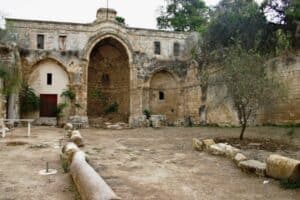
The gate of Sepphoris
We used to think of Jesus and his Nazareth compatriots as essentially backward, uneducated Galilean country folk who probably could not read or write and were ignorant of the rest of the world. Although the town of Sepphoris was known throughout the Middle Ages, archaeologists did not rediscover and explore it until the 20th century. Located just four miles from Nazareth, Sepphoris was the major Roman city in Galilee during Jesus’ time.
Sepphoris was a small metropolis and significant in the Roman view of Palestine. Recently conquered and rebuilt by the Romans during Josephus’ time in the final decades of what we call the pre-Christian era, this city featured a large theater, numerous business sites, and a large marketplace. Indeed, it appears to have been rebuilt during the very years covered by the early chapters of the New Testament Gospels. It seems likely that Jesus’ father, Joseph, a carpenter, might have worked on the Roman rebuilding of this town. Perhaps even Jesus himself worked there as a carpenter in the years before his preaching ministry began.
In the late 1960s, a faculty colleague of mine spent summers conducting archaeological work at Sepphoris. He, along with other biblical scholars, remains puzzled by why this town is not mentioned in the Gospels. It would seem that carpenters and other workers like Joseph would have been employed in the town’s rebuilding, yet it goes entirely unmentioned in the New Testament. After all, it was just an hour’s walk from Nazareth, and even Josephus, the Jewish/Roman historian, mentions this little city several times in his Jewish Antiquities.
Indeed, it seems strange that in the Gospel accounts of Jesus’ ministry, when he visits numerous villages around his home in Nazareth, there is no mention of Sepphoris. After all, the two towns were only about four miles apart. If Jesus grew up in this immediate area, one would surely expect some reference to this town, no matter how brief. A quick look at a map of the area at that time reveals numerous towns and villages scattered throughout the region northwest of the Sea of Galilee, many of which, such as Capernaum, Tiberias, and Cana, are mentioned in the Gospels as places Jesus visited.
This geographic mystery, in which an important city is completely neglected in the Gospel accounts, parallels the complete absence of any biblical references to Jesus’ early life, specifically the years between his birth and the beginning of his preaching ministry. There were, to be sure, other attempts to fill in the gaps concerning Jesus’ youth and upbringing, but these have all been set aside by biblical scholars as fanciful. They revolve around stories of Jesus bringing his carved animals to life and beating his childhood friends in races. Apparently, the Gospel writers deemed any details about Jesus’ early years superfluous to the story of his adult preaching and healing ministry.
Still, it remains puzzling that the Bible contains no reference to any part of Jesus’ life as a child or young man. Scholars conjecture that he began his public ministry around the age of 27 or 30. All things prior to those years are seen as irrelevant. We gain some insight into those years by extrapolating from his manner of speech and behavior during his public ministry, but such speculation yields very little. Perhaps, for the purposes of conveying the meaning of his message and life, these are sufficient. Nevertheless, I remain spiritually curious about further details and extrapolations.
Without anything more to go on, I nonetheless enjoy speculating about what sort of person Jesus was, simply as a person. I can imagine him arriving for work in Sepphoris, full of life and openness toward others, careful to cut the boards well and drive the nails straight, and enjoying the opportunity to contribute to his family’s well-being. The fact that Sepphoris was a town makes this possibility plausible.