Dr. King’s Assassination Remembered
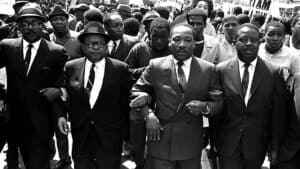
Martin Luther King Jr.’s last march in Memphis
When Dr. King was assassinated in Memphis in 1968, I was living and teaching there. I taught at what is now Rhodes College and at Lemoyne-Owen College, a traditional Black College. Dr. King had come to Memphis to support the local sanitation workers’ strike. They were trying to start a union in Memphis because, up until then, the men who collected the city’s garbage had no rights whatsoever. No health benefits, no sick leave, and no vacation time.
In a TV interview with the mayor, the lead representative for the Black workers was told: “You don’t want to go the Union route. Unions are all corrupt.” The workers’ coordinator replied: “Yes, they are. About half as corrupt as most city governments.” The situation had reached a breaking point, so Dr. King was invited to come in and resolve it. The garbage workers went on strike for six or seven weeks and were supported by the AF of L and CIO unions. The city streets and neighborhoods smelled like the dump itself.
Memphis had always been a fully segregated city, but when King was killed, the city simply came apart. The entire city was under a nighttime lockdown and strict daytime curfews. Soon, the Mayor and Community organizers sponsored a huge march through the city streets, right up to City Hall. Many prominent supporters of the strike addressed the large crowd. Harry Belafonte, Bill Cosby, and several soul groups performed on stage. Rev. James Lawson served as master of ceremonies.
At one point during the festivities, a group of young Black people began smashing store windows and engaging in serious looting. Almost at once, the March’s Coordinator called out over the sound system: “Down. Right now, everyone get down.” Almost instantly, some 5,000 people knelt in the street so the police could round up the looters. From then on, things went very smoothly. This march became known as the “I am a Man” march because so many people carried signs with that motto.
My 13-year-old son and I participated in this march, and to this day he affirms it was a turning point in his life. I must admit that I, too, count this march as a turning point in my life. Since that day, Memphis has become a different, more open city, though there is still a long way to go. The strike was settled, the sanitation workers secured their union, and several white churches organized tours through the ghetto areas so white folks could see the difficulties facing folks living in Black communities.
For the couple of years before March, I had taught at the local Black College and developed close friendships with several of my students. During the difficult days right after the assassination, the college held a memorial service for Dr. King, and two of my students called to ask whether I would like to attend with them. I was deeply touched by their invitation and promptly accepted. It was a great privilege to honor Dr. King alongside my students.
This experience has remained a crucial turning point in my political and spiritual development. I continue to pray that Dr. King’s sacrifice will ultimately prove effective and worth it. The developments since that time have a mixed record – some progress, but also a lot of regression. It is important for us Americans to continue the dream of our Founding Fathers and of Dr. King, as symbolized by the Statue of Liberty: Bring all people together as one in this land.